Track 01 · Security
Decision Advantage at Sea
Turning fragmented maritime signals into decision advantage, strategically and operationally.
Every challenge follows the same structure. Each track has a shared theme. Within it, each partner company has an arena: a real problem from their operations, a concrete build assignment, and a defined deliverable. Pick one arena and build for it. Whatever you build in one arena will be instructive to every partner in that track.
Background
Nordic naval operations depend on a system of systems: submarines, surface vessels, coastal radars, underwater sensors, and naval bases. The data that describes their configuration, status, and health is scattered across legacy PDFs, OEM systems, PLM/ILS tools, and spreadsheets. The result is the same failure at two altitudes: leadership cannot see fleet-level risk, and engineers cannot trust document-level detail. Both problems are decision problems, and both are solvable with AI on top of the data that already exists.
Choose your arena
The problem
Strategic questions like "which assets are single points of failure for coastal surveillance?" or "what happens if this base closes for a week?" cannot be answered today without weeks of manual analysis across disconnected systems. By the time the answer arrives, the situation has changed.
Build
A fleet resilience engine. Ingest assets (platforms, coastal sensors, bases, key nodes) with attributes and dependency links; compute per-asset risk scores from health, logistics, and network impact; visualise risk on a map or graph; run what-if scenarios (base closed for 7 days, radar chain segment down, spare part shortage) with impact metrics and natural-language explanations; and suggest a ranked list of resilience actions for the next 30–90 days.
Deliverable
A working web or tablet prototype where a user can see fleet-level risk, run a what-if scenario, and read a ranked, explained action list.
Data sources
Synthetic, non-classified JSON/CSV dataset from Saab — a small notional Nordic naval force with assets, dependency links, health and maintenance events, spares, missions, and scenario presets.
The problem
Engineers lose hours locating the correct document revision for a specific hull and manually producing inspection reports. Refits slow down, and the risk grows that outdated information is used onboard.
Build
An engineering co-pilot. Let a user pick a hull, compartment, system, and task; surface the correct procedures, drawings, limits, and safety notes; answer natural-language questions ("What tests are required after replacing this module?"); detect configuration issues such as revision mismatches; and draft work and inspection reports from task context and user notes.
Deliverable
A working web or tablet prototype where a user can navigate to a specific task, get the correct verified documentation, and generate a draft inspection report.
Data sources
Synthetic, non-classified JSON/CSV dataset from Saab — a notional vessel with compartments, systems, technical documents, tasks, configuration rules, historical issues, and report templates.
Shared requirement for all teams
Your architecture must address shipyard and dockyard reality: intermittent connectivity and security constraints. Include an architecture sketch in your pitch showing how the system behaves when the network is not there.
Saab dataset
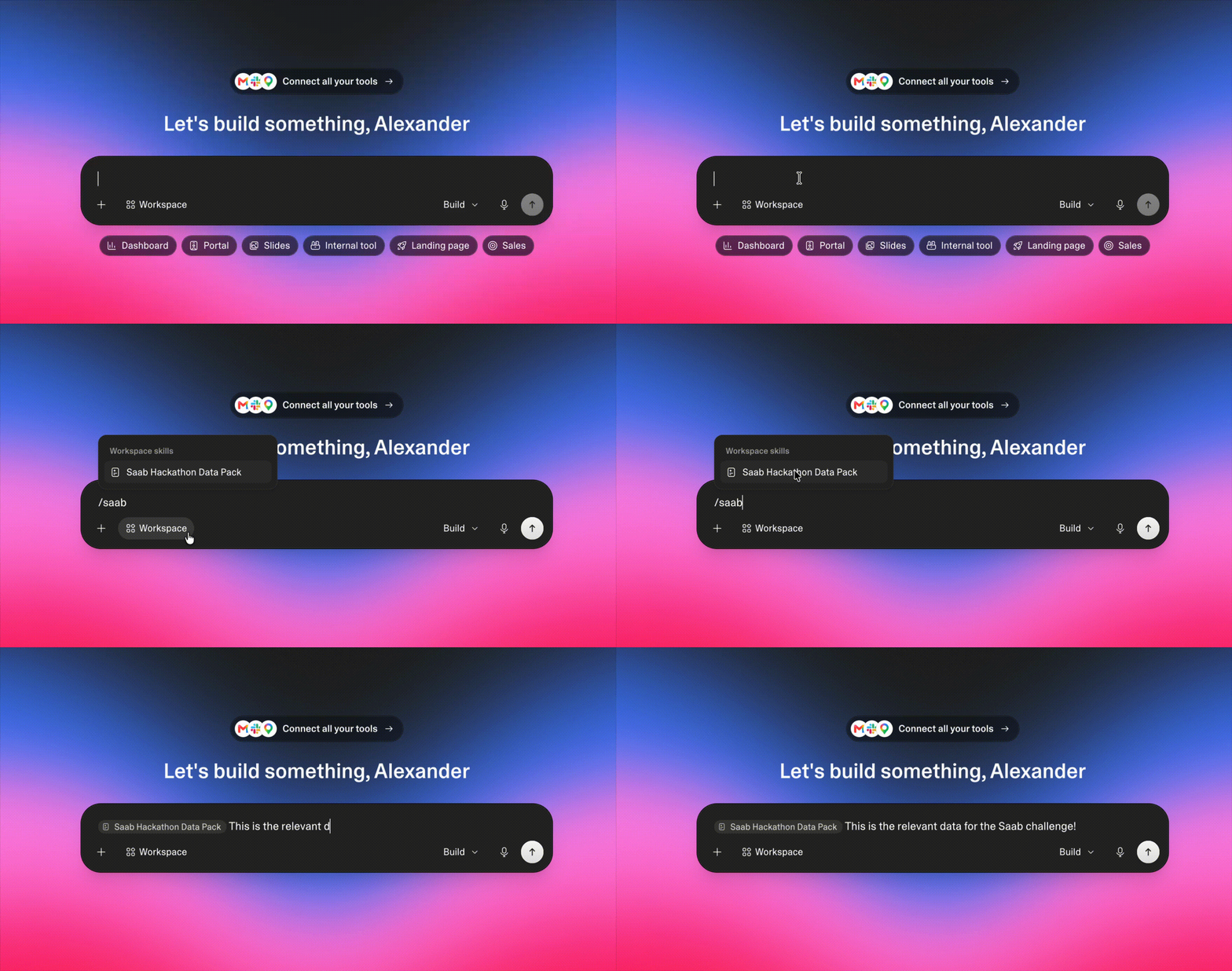
The Saab challenge data is available natively inside Lovable through the Saab Hackathon Data Pack skill.
Open a prompt in Lovable and type / to open the skill menu, then select Saab Hackathon Data Pack.
Sample prompt: "Populate the app using the attached dataset in this skill."
Need help? Reach out to Alexander, Tomas or Thaer on site.
Teams receive a structured, lightweight synthetic data pack designed to be understood in 20 minutes and loaded in under 5 minutes. The data is intentionally thin but connected. We are not attempting to simulate a real fleet or production system. We are giving teams enough linked context to demonstrate real reasoning: a revision mismatch, a missing test, a dependency cascade or a constrained spare allocation.
Pitch
A short pitch covering the end user, where in the operation your solution deploys, and what it would take to run in production.
Data sources (all arenas)
Both arenas: optional starter notebooks (Python/TypeScript) with a minimal API, a context pack on naval environments and constraints, and access to Saab mentors on-site for questions on realism and deployment architecture.